
MAPIE — Model Agnostic Prediction Interval Estimator
An open-source Python library for quantifying uncertainties and controlling the risks of machine learning models.







🚀 MAPIE in 2026 🚀 New features have been implemented, starting with the application of risk control to emerging use cases such as LLM-as-Judge and image segmentation. In addition, exchangeability tests have been introduced to help users verify when MAPIE can be legitimately applied. Also, new adaptive conformal prediction methods have been added. Finally, the documentation has been updated with a new design!
🎉 MAPIE in 2025 🎉 MAPIE v1 is live! You're seeing the documentation of this new version, which introduces major changes to the API. Extensive release notes are available in the documentation. You can switch to the documentation of previous versions using the Read the Docs version menu.
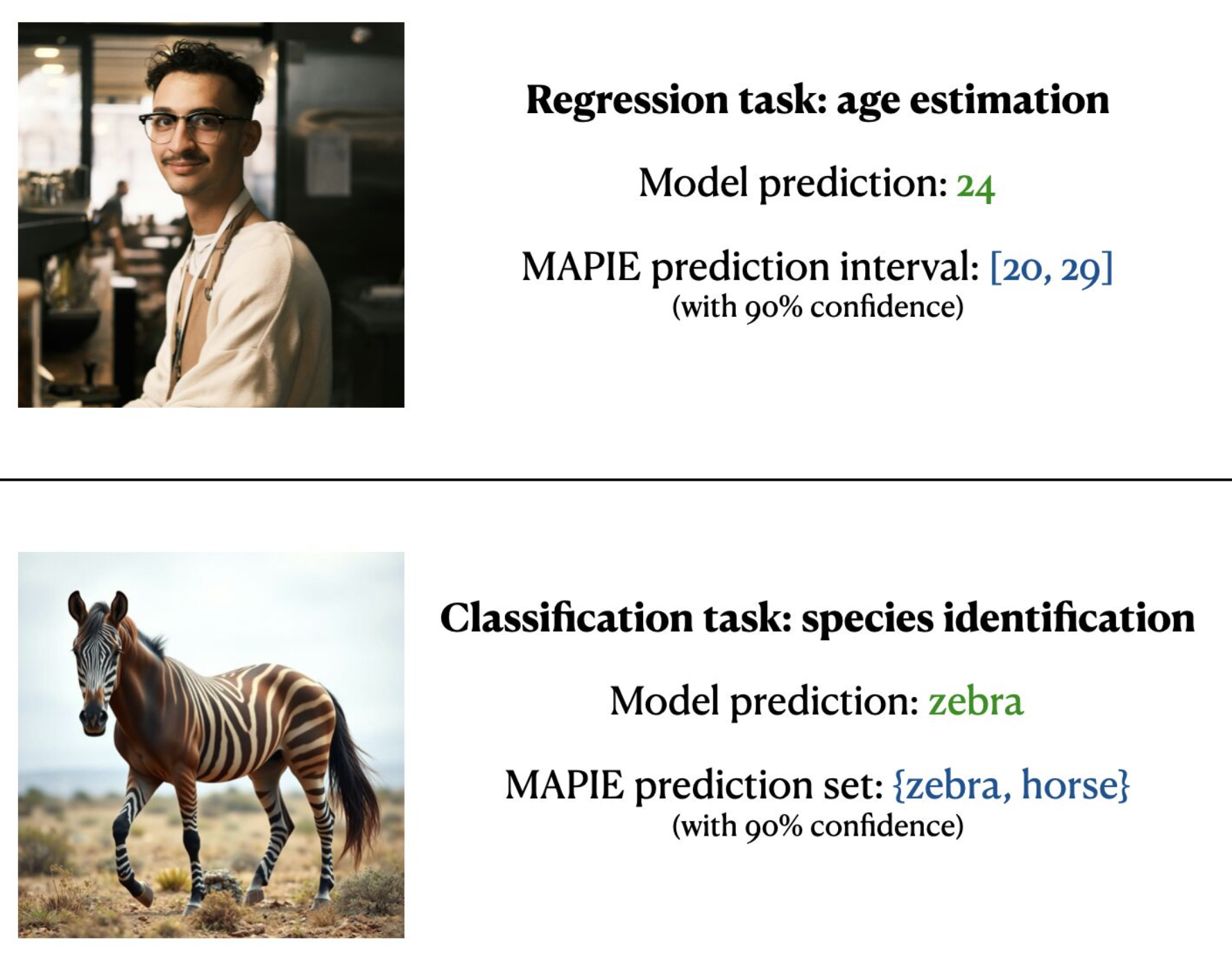
Image credits: Cemrecan Yurtman (portrait) and hogrmahmood (zebra-horse hybrid).
What can MAPIE do?
Prediction Intervals & Sets
Compute prediction intervals (regression, time series) or prediction sets (classification) using state-of-the-art conformal prediction methods.
MAPIE implements peer-reviewed algorithms with theoretical guarantees under minimal assumptions, based on Conformal Prediction and Distribution-Free Inference.
Risk Control
Control prediction errors for complex tasks: multi-label classification, semantic segmentation, with probabilistic guarantees on precision and recall.
Model Agnostic
Use any model — scikit-learn, TensorFlow, PyTorch — thanks to scikit-learn-compatible wrappers. Part of the scikit-learn-contrib ecosystem.
 All Examples
Explore our gallery of hands-on examples covering all MAPIE use cases:
Conditional Conformal Prediction
Conditional prediction intervals and prediction sets.
Exchangeability Testing
Test distribution shifts and monitor exchangeability assumptions.
Educational Notebooks
Work through guided regression and LLM conformal-prediction exercises, then compare your solutions with the completed versions.
 Quick Install
See the Quick Start for other installation methods, requirements, and a first example.
 Citation
If you use MAPIE in your research, please cite the main paper:
Cordier, Thibault, et al. "Flexible and systematic uncertainty estimation with conformal prediction via the MAPIE library." Conformal and Probabilistic Prediction with Applications. PMLR, 2023.
@inproceedings{Cordier_Flexible_and_Systematic_2023,
    author = {Cordier, Thibault and Blot, Vincent and Lacombe, Louis and Morzadec, Thomas and Capitaine, Arnaud and Brunel, Nicolas},
    booktitle = {Conformal and Probabilistic Prediction with Applications},
    title = {{Flexible and Systematic Uncertainty Estimation with Conformal Prediction via the MAPIE library}},
    year = {2023}
}
You can also cite the ICML workshop manuscript:
Taquet, Vianney, et al. "MAPIE: an open-source library for distribution-free uncertainty quantification." arXiv preprint arXiv:2207.12274 (2022).
@article{taquet2022mapie,
    title = {MAPIE: an open-source library for distribution-free uncertainty quantification},
    author = {Taquet, Vianney and Blot, Vincent and Morzadec, Thomas and Lacombe, Louis and Brunel, Nicolas},
    journal = {arXiv preprint arXiv:2207.12274},
    year = {2022}
}
 Affiliations
MAPIE has been developed through a collaboration between Capgemini Invent, Quantmetry, Michelin, ENS Paris-Saclay, and with the financial support from Région Île-de-France and Confiance.ai.