mapie.classification.SplitConformalClassifier
- class mapie.classification.SplitConformalClassifier(estimator: ClassifierMixin = LogisticRegression(), confidence_level: float | Iterable[float] = 0.9, conformity_score: str | BaseClassificationScore = 'lac', prefit: bool = True, n_jobs: int | None = None, verbose: int = 0, random_state: int | RandomState | None = None)[source]
Computes prediction sets using the split conformal classification technique:
The fit method (optional) fits the base classifier to the training data.
The conformalize method estimates the uncertainty of the base classifier by computing conformity scores on the conformalization set.
The predict_set method predicts labels and sets of labels.
- Parameters:
- estimatorClassifierMixin, default=LogisticRegression()
The base classifier used to predict labels.
- confidence_levelUnion[float, List[float]], default=0.9
The confidence level(s) for the prediction sets, indicating the desired coverage probability of the prediction sets. If a float is provided, it represents a single confidence level. If a list, multiple prediction sets for each specified confidence level are returned.
- conformity_scoreUnion[str, BaseClassificationScore], default=”lac”
The method used to compute conformity scores.
Valid options:
“lac”
“top_k”
“aps”
“raps”
Any subclass of BaseClassificationScore
A custom score function inheriting from BaseClassificationScore may also be provided.
See [theoretical description (classification)](../theory/classification.md).
- prefitbool, default=True
If True, the base classifier must be fitted, and the fit method must be skipped.
If False, the base classifier will be fitted during the fit method.
- n_jobsOptional[int], default=None
The number of jobs to run in parallel when applicable.
- verboseint, default=0
Controls the verbosity level. Higher values increase the output details.
Examples
>>> from mapie.classification import SplitConformalClassifier
>>> from mapie.utils import train_conformalize_test_split
>>> from sklearn.datasets import make_classification
>>> from sklearn.neighbors import KNeighborsClassifier
>>> X, y = make_classification(n_samples=500)
>>> (
...     X_train, X_conformalize, X_test,
...     y_train, y_conformalize, y_test
... ) = train_conformalize_test_split(
...     X, y, train_size=0.6, conformalize_size=0.2, test_size=0.2, random_state=1
... )
>>> mapie_classifier = SplitConformalClassifier(
...     estimator=KNeighborsClassifier(),
...     confidence_level=0.95,
...     prefit=False,
... ).fit(X_train, y_train).conformalize(X_conformalize, y_conformalize)
>>> predicted_labels, predicted_sets = mapie_classifier.predict_set(X_test)
- __init__(estimator: ClassifierMixin = LogisticRegression(), confidence_level: float | Iterable[float] = 0.9, conformity_score: str | BaseClassificationScore = 'lac', prefit: bool = True, n_jobs: int | None = None, verbose: int = 0, random_state: int | RandomState | None = None) None[source]
- conformalize(X_conformalize: ArrayLike, y_conformalize: ArrayLike, predict_params: dict | None = None) SplitConformalClassifier[source]
Estimates the uncertainty of the base classifier by computing conformity scores on the conformalization set.
- Parameters:
- X_conformalizeArrayLike
Features of the conformalization set.
- y_conformalizeArrayLike
Targets of the conformalization set.
- predict_paramsOptional[dict], default=None
Parameters to pass to the predict and predict_proba methods of the base classifier. These parameters will also be used in the predict_set and predict methods of this SplitConformalClassifier.
- Returns:
- Self
The conformalized SplitConformalClassifier instance.
- fit(X_train: ArrayLike, y_train: ArrayLike, fit_params: dict | None = None) SplitConformalClassifier[source]
Fits the base classifier to the training data.
- Parameters:
- X_trainArrayLike
Training data features.
- y_trainArrayLike
Training data targets.
- fit_paramsOptional[dict], default=None
Parameters to pass to the fit method of the base classifier.
- Returns:
- Self
The fitted SplitConformalClassifier instance.
- predict(X: ArrayLike) ndarray[tuple[Any, ...], dtype[_ScalarT]][source]
For each sample in X, returns the predicted label by the base classifier.
- Parameters:
- XArrayLike
Features
- Returns:
- NDArray
Array of predicted labels, with shape (n_samples,).
- predict_set(X: ArrayLike, conformity_score_params: dict | None = None) Tuple[ndarray[tuple[Any, ...], dtype[_ScalarT]], ndarray[tuple[Any, ...], dtype[_ScalarT]]][source]
For each sample in X, predicts a label (using the base classifier), and a set of labels.
If several confidence levels were provided during initialisation, several sets will be predicted for each sample. See the return signature.
- Parameters:
- XArrayLike
Features
- conformity_score_paramsOptional[dict], default=None
Parameters specific to conformity scores, used at prediction time.
The only example for now is include_last_label, available for aps and raps conformity scores. For detailed information on include_last_label, see the docstring of APSConformityScore.get_prediction_sets.
- Returns:
- Tuple[NDArray, NDArray]
Two arrays:
Prediction labels, of shape (n_samples,)
Prediction sets, of shape (n_samples, n_class, n_confidence_levels)
Examples using mapie.classification.SplitConformalClassifier
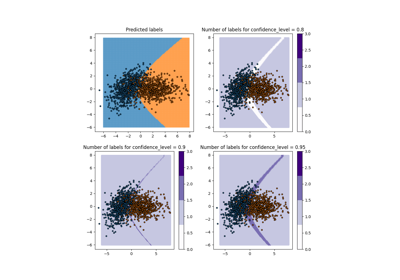
Set prediction example in the binary classification setting
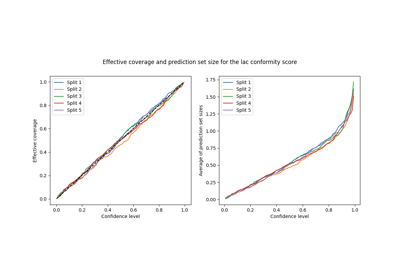
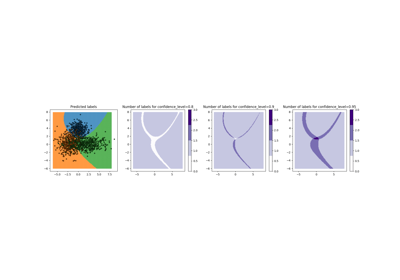
Least Ambiguous Set-Valued Classifiers with Bounded Error Levels, Sadinle et al. (2019)
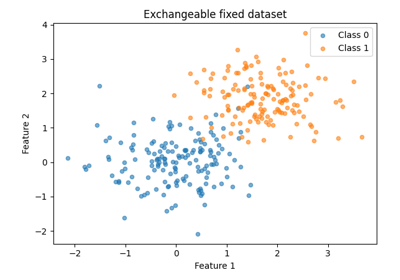
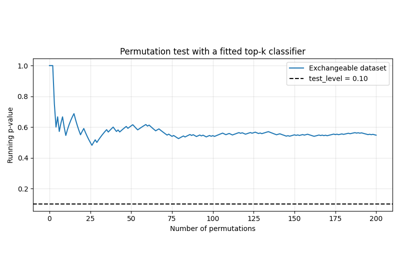
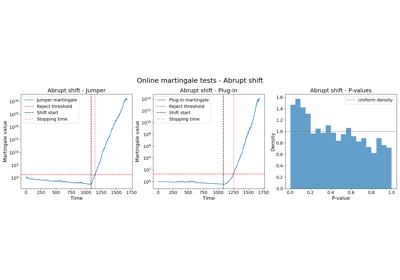
Online martingale exchangeability tests for a deployed classifier