Note
Click here to download the full example code
Conditional calibration with ConditionalSplitConformalRegressor
This example reproduces the 1D synthetic experiment of Gibbs, Cherian and
Candès (2023) [1], using MAPIE's
:class:~mapie.conditional_conformal_prediction.ConditionalSplitConformalRegressor.
The plot below mirrors the figure produced by the SyntheticData.ipynb notebook
of the authors' reference implementation [2]: it compares a standard
(marginal) split-conformal interval to the conditionally-calibrated interval on
the same data and base model.
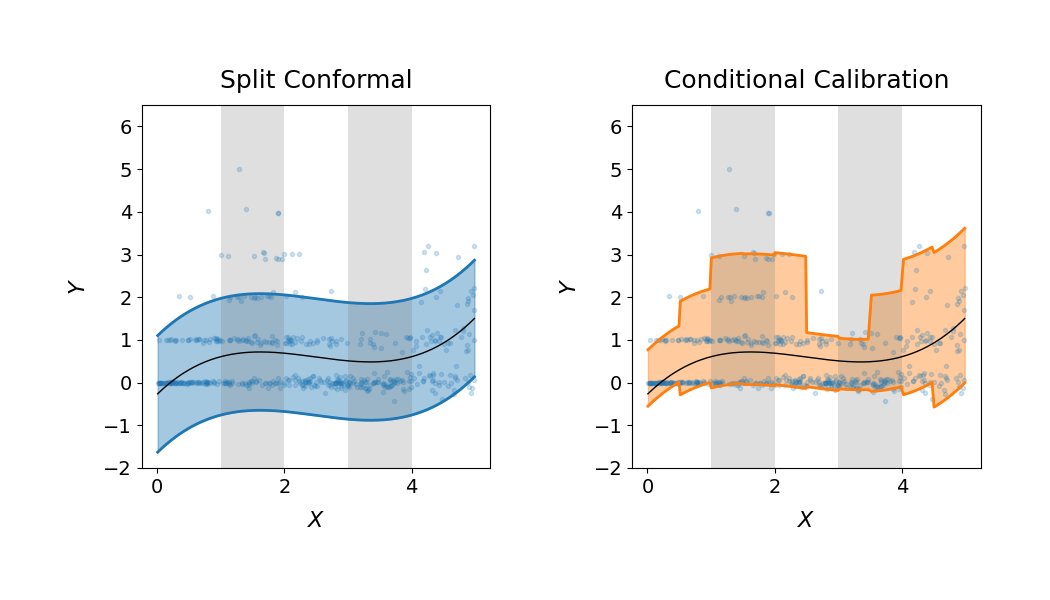
The data is heteroscedastic: the conditional spread of Y varies strongly
with X. A marginal split-conformal interval uses a single score cutoff for
every X, so it is too wide where the noise is small and too narrow where it
is large. The conditional procedure instead guarantees coverage over a chosen
finite class of covariate shifts -- here the indicators of the sub-intervals
[0, 0.5), [0.5, 1), ..., [4.5, 5) -- and therefore adapts the interval width
to X.
[1] Isaac Gibbs, John J. Cherian, Emmanuel J. Candès. "Conformal Prediction With Conditional Guarantees." arXiv:2305.12616, 2023.
[2] https://github.com/jjcherian/conditional-conformal
import warnings

import matplotlib.pyplot as plt
import numpy as np
import pandas as pd
from sklearn.linear_model import LinearRegression
from sklearn.pipeline import make_pipeline
from sklearn.preprocessing import PolynomialFeatures

from mapie.conditional_conformal_prediction import ConditionalSplitConformalRegressor
from mapie.conformity_scores import AbsoluteConformityScore

warnings.filterwarnings("ignore")
1. Generating the synthetic data
We use the exact data-generating process of the reference implementation. The
mean of Y follows a smooth function of X on [0, 5], with a
Poisson-like component, a small X-dependent Gaussian noise, and rare large
outliers. The conditional variance is clearly heteroscedastic in X.
def generate_cqr_data(seed, n_train=2000, n_calib=1000, n_test=500):
    np.random.seed(seed)

    n_train = n_train + n_calib

    def f(x):
        """Construct data (1D example)"""
        ax = 0 * x
        for i in range(len(x)):
            ax[i] = (
                np.random.poisson(np.sin(x[i]) ** 2 + 0.1)
                + 0.03 * x[i] * np.random.randn(1)
            ).item()
            ax[i] += (
                25 * (np.random.uniform(0, 1, 1) < 0.01) * np.random.randn(1)
            ).item()
        return ax.astype(np.float32)

    x_train = np.random.uniform(0, 5.0, size=n_train).astype(np.float32)
    x_test = np.random.uniform(0, 5.0, size=n_test).astype(np.float32)

    y_train = f(x_train)
    y_test = f(x_test)

    x_train = np.reshape(x_train, (n_train, 1))
    x_test = np.reshape(x_test, (n_test, 1))

    train_set_size = len(y_train) - n_calib
    x_train_final = x_train[:train_set_size]
    x_calib = x_train[train_set_size:]
    y_train_final = y_train[:train_set_size]
    y_calib = y_train[train_set_size:]

    return x_train_final, y_train_final, x_calib, y_calib, x_test, y_test


def indicator_matrix(scalar_values, disc):
    scalar_values = np.array(scalar_values)

    # Create all possible intervals
    intervals = [(disc[i], disc[i + 1]) for i in range(len(disc) - 1)]

    # Initialize the indicator matrix
    matrix = np.zeros((len(scalar_values), len(intervals)))

    # Fill in the indicator matrix
    for i, value in enumerate(scalar_values):
        for j, (a, b) in enumerate(intervals):
            if a <= value < b:
                matrix[i, j] = 1

    return matrix


x_train_final, y_train_final, x_calib, y_calib, x_test, y_test = generate_cqr_data(
    seed=1, n_calib=2000
)

x_calib = np.asarray(x_calib, dtype=np.float64)
y_calib = np.asarray(y_calib, dtype=np.float64)
2. Fitting the base regressor
Following the reference experiment, the base model is a fourth-order
polynomial regression. The polynomial features are wrapped in a
:class:~sklearn.pipeline.Pipeline so that the estimator can be called
directly on the raw covariate X: MAPIE calls predict on the raw
features internally, and the conditional basis feature_map below is also
defined on the raw X.
reg = make_pipeline(PolynomialFeatures(4), LinearRegression()).fit(
    x_train_final, y_train_final
)

confidence_level = 0.9
alpha = 1 - confidence_level
3. Defining the conditional guarantee
feature_map defines the finite-dimensional class of covariate shifts over which
exact coverage is guaranteed. Here we use the indicators of the sub-intervals
with endpoints in [0, 0.5, 1, ..., 5]: coverage is then valid not only
marginally, but on each of these groups of X.
4. Conditional calibration with MAPIE
We use a non-symmetric :class:~mapie.conformity_scores.AbsoluteConformityScore
(the residual Y - reg.predict(X)), so that the lower and upper bounds are
calibrated separately. The base model is already fitted, hence prefit=True.
predict_interval solves, for each test point, a small linear program that
yields the conditionally-valid score cutoff.
mapie_conditional = ConditionalSplitConformalRegressor(
    phi_fn,
    estimator=reg,
    prefit=True,
    confidence_level=confidence_level,
    conformity_score=AbsoluteConformityScore(sym=False),
)
mapie_conditional.conformalize(x_calib, y_calib)

n_test = len(x_test)
lbs = np.zeros((n_test,))
ubs = np.zeros((n_test,))
for i, x_t in enumerate(x_test):
    _, interval = mapie_conditional.predict_interval(x_t.reshape(1, -1))
    lbs[i] = interval[0, 0, 0]
    ubs[i] = interval[0, 1, 0]
5. Marginal split-conformal baseline
As a reference, we also compute the standard split-conformal interval, which
uses a single marginal quantile of the absolute residuals on the calibration
set. This interval has constant half-width q for every X.
q = np.quantile(
    np.abs(reg.predict(x_calib) - y_calib),
    np.ceil((len(x_calib) + 1) * confidence_level) / len(x_calib),
)
6. Comparing the two intervals
The left panel shows the marginal split-conformal interval (constant width).
The right panel shows the conditional calibration: the interval narrows where
the conditional noise is small and widens where it is large, while keeping the
target coverage on each of the highlighted groups of X. This reproduces the
figure of the original implementation [2].
plt.rcParams["font.family"] = "DejaVu Sans"
cp = plt.rcParams["axes.prop_cycle"].by_key()["color"]
fig = plt.figure()
fig.set_size_inches(10.5, 6)

sort_order = np.argsort(x_test[0:n_test, 0])
x_test_s = x_test[sort_order]
y_test_s = y_test[sort_order]
y_test_hat = reg.predict(x_test[sort_order])
lb = lbs[sort_order]
ub = ubs[sort_order]

ax1 = fig.add_subplot(1, 2, 1)
ax1.plot(x_test_s, y_test_s, ".", alpha=0.2)
ax1.plot(x_test_s, y_test_hat, lw=1, color="k")
ax1.plot(x_test_s, y_test_hat + q, color=cp[0], lw=2)
ax1.plot(x_test_s, y_test_hat - q, color=cp[0], lw=2)
ax1.fill_between(
    x_test_s.flatten(),
    y_test_hat - q,
    y_test_hat + q,
    color=cp[0],
    alpha=0.4,
    label="split prediction interval",
)
ax1.set_ylim(-2, 6.5)
ax1.tick_params(axis="both", which="major", labelsize=14)
ax1.set_xlabel("$X$", fontsize=16, labelpad=10)
ax1.set_ylabel("$Y$", fontsize=16, labelpad=10)
ax1.set_title("Split Conformal", fontsize=18, pad=12)
ax1.axvspan(1, 2, facecolor="grey", alpha=0.25)
ax1.axvspan(3, 4, facecolor="grey", alpha=0.25)

ax2 = fig.add_subplot(1, 2, 2, sharex=ax1, sharey=ax1)
ax2.plot(x_test_s, y_test_s, ".", alpha=0.2)
ax2.plot(x_test_s, y_test_hat, color="k", lw=1)
ax2.plot(x_test_s, ub, color=cp[1], lw=2)
ax2.plot(x_test_s, lb, color=cp[1], lw=2)
ax2.fill_between(
    x_test_s.flatten(),
    lb,
    ub,
    color=cp[1],
    alpha=0.4,
    label="conditional calibration",
)
ax2.tick_params(axis="both", which="major", direction="out", labelsize=14)
ax2.set_xlabel("$X$", fontsize=16, labelpad=10)
ax2.set_ylabel("$Y$", fontsize=16, labelpad=10)
ax2.set_title("Conditional Calibration", fontsize=18, pad=12)
ax2.axvspan(1, 2, facecolor="grey", alpha=0.25)
ax2.axvspan(3, 4, facecolor="grey", alpha=0.25)

plt.tight_layout(pad=5)
plt.show()
7. Group-conditional miscoverage over repeated trials
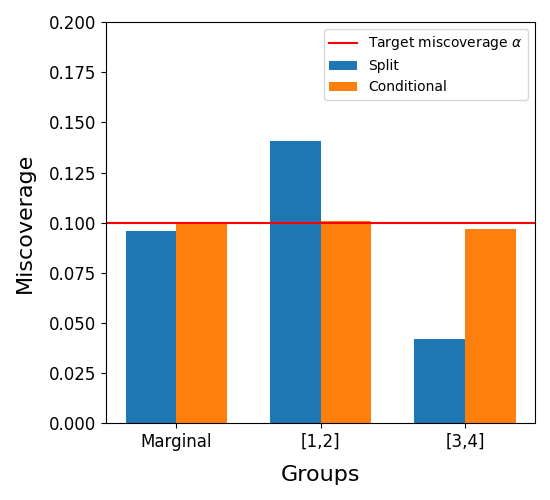
We now quantify the coverage difference between the two methods. Following
the reference notebook [2], we repeat the experiment over independent draws
of the calibration and test sets (keeping the fitted base model), and
measure the miscoverage rate of both methods, marginally and on the two
highlighted groups X in [1, 2] and X in [3, 4]. The conditional
procedure is run with randomize=True so that its coverage is exact
rather than conservative.
Both methods control the marginal miscoverage at the nominal 10% level
(red line), but the split-conformal interval (blue, as in the figure above)
undercovers on [1, 2] -- where the noise is large -- and overcovers on
[3, 4] -- where it is small. The conditional calibration (orange)
achieves the nominal miscoverage on both groups. The original experiment
uses 500 trials; we use fewer here to keep the runtime of the example
reasonable.
n_trials = 20
rows = []
for seed in range(n_trials):
    _, _, x_calib_t, y_calib_t, x_test_t, y_test_t = generate_cqr_data(
        seed=seed, n_calib=2000
    )
    x_calib_t = np.asarray(x_calib_t, dtype=np.float64)
    y_calib_t = np.asarray(y_calib_t, dtype=np.float64)
    x_test_t = np.asarray(x_test_t, dtype=np.float64)

    mapie_trial = ConditionalSplitConformalRegressor(
        phi_fn,
        estimator=reg,
        prefit=True,
        confidence_level=confidence_level,
        conformity_score=AbsoluteConformityScore(sym=False),
        randomize=True,
        seed=seed,
    ).conformalize(x_calib_t, y_calib_t)
    _, intervals = mapie_trial.predict_interval(x_test_t)
    miscover_conditional = (y_test_t < intervals[:, 0, 0]) | (
        y_test_t > intervals[:, 1, 0]
    )

    q_t = np.quantile(
        np.abs(reg.predict(x_calib_t) - y_calib_t),
        np.ceil((len(x_calib_t) + 1) * confidence_level) / len(x_calib_t),
    )
    miscover_split = np.abs(reg.predict(x_test_t) - y_test_t) >= q_t

    x_t = x_test_t[:, 0]
    groups = {
        "Marginal": np.ones_like(x_t, dtype=bool),
        "[1,2]": (x_t > 1) & (x_t < 2),
        "[3,4]": (x_t > 3) & (x_t < 4),
    }
    for method, miscover in [
        ("Split", miscover_split),
        ("Conditional", miscover_conditional),
    ]:
        for group_name, mask in groups.items():
            rows.append(
                {
                    "Method": method,
                    "Groups": group_name,
                    "Miscoverage": miscover[mask].mean(),
                }
            )

coverage_data = pd.DataFrame(rows)
coverage_summary = coverage_data.groupby(["Groups", "Method"], as_index=False)[
    "Miscoverage"
].mean()

fig, ax3 = plt.subplots(figsize=(5.5, 5))
group_names = ["Marginal", "[1,2]", "[3,4]"]
method_names = ["Split", "Conditional"]
x_pos = np.arange(len(group_names))
bar_width = 0.35
offsets = [-bar_width / 2, bar_width / 2]

for offset, method_name, color in zip(offsets, method_names, cp[:2]):
    method_values = coverage_summary[coverage_summary["Method"] == method_name]
    heights = [
        method_values[method_values["Groups"] == group_name]["Miscoverage"].item()
        for group_name in group_names
    ]
    ax3.bar(
        x_pos + offset,
        heights,
        width=bar_width,
        label=method_name,
        color=color,
    )

ax3.axhline(alpha, color="red", label=r"Target miscoverage $\alpha$")
ax3.legend()
ax3.set_ylabel("Miscoverage", fontsize=16, labelpad=10)
ax3.set_xlabel("Groups", fontsize=16, labelpad=10)
ax3.set_ylim(0.0, 0.2)
ax3.set_xticks(x_pos)
ax3.set_xticklabels(group_names)
ax3.tick_params(axis="both", which="major", labelsize=12)
plt.tight_layout()
plt.show()
Total running time of the script: ( 0 minutes 15.066 seconds)
Download Python source code: plot_gibbs2023_conditional_conformal.py
Download Jupyter notebook: plot_gibbs2023_conditional_conformal.ipynb